Thursday, August 4, 2011

Mass Amatuerization


In Clay Shirky’s chapter “Everyone is a Media Outlet” he uses the term “mass amateurization” to describe the development of technology and how it has evolved by once being placed on professionals, and how it had slowly been moved on to the common man. Tools that were once so expensive and limited to only professionals are now being sold to everyone allowing accessibility and widespread usage. With this lift, everyone can produce and publish work just as how professionals once did.


According to Shirky “Mass amateurization is a result of the radical spread of expressive capabilities, and the most obvious precedent is the one that gave birth to the modern world: the spread of the printing press five centuries ago” (66). This suggests that anyone can publish work and not just the professionals. It seems that nowadays mass amateurization is occurring in every subject matter, but it can be found most strongly in the media. Shirky gives the very first example of mass amateurization to bloggers, who covered Trent Lott , the senior senator from Mississippi. Shirky goes on to say “Information that might be of interest to the general public may not be published, not because of a conspiracy but because the editors have professional bias that is aligned by the similar tools they use to approach those challenges. The mass amateurization of publishing undoes the limitations inherent in having a small number of traditional press outlets” (65).


Photography is another work where the common man can produce work. Anyone can acquire a camera and publish their work on internet sites such as Flickr, and have millions of people view their work. Youtube is another site that allows either amateur and professional videos.


The media plays a big part in mass amateurization because the internet allows a number of vast opportunities for the common person to learn the tools of the trade. Shirky argues that the outcome of mass amateurization is "because professionals are always concerned with threats to the profession. In most cases, those threats are also threats to society; we do not want to see a relaxing of standards for becoming a surgeon or a pilot. But in some cases the change that threatens the profession benefits society" (69). Through Shirky's statement he contemplates on how the outcome can have both positive and negative effects. He believes that organizations think they have more power than they actually do and that in reality they don't because what happens in society is out of their control. Shirky continues on by saying "There is never going to be a moment when we as society ask ourselves, "Do we want this? Do we want the changes that the new flood of production and access and spread of information is going to bring about?" It has already happened; in many ways the rise of group forming networks is best viewed not as an invention but as an event, a thing that has happened in the world that can't be undone" (73). Through Shirky's statement he argues that what's happened cannot be undone and mass amateurization is a phenomenon that we as society should embrace because it has given people an outlet to produce and show our work.


I feel that in the future the media outlet is going to rely heavily on the viewing of a lot of amateur work because it has given us the power to do so. I also think that because of the number of bloggers producing news that editors from companies try to censor, its going to really give a fight to news companies to cover stories that matter or they'll lose all their customers.


Shirky, Clay. "Everyone Is a Media Outlet." Here Comes Everybody: the Power of Organizing Without Organizations. New York. Penguin. 2008.

Shirky and Mass Amateurization

Clay Shirky's coinage of the term "mass amateurization" comes at a very key time in the history of media and communication. Mass amateurization, as explained by Shirky in “Everyone is a Media Outlet”, refers to the phenomenon that occurs when scarcity and barriers to entry are removed (or lessened) from a previously only-professional field. These barriers being lifted makes it easier for “commoners” to spread information in a way that was previously impossible.
In photography, every person being able to acquire a digital camera and publish those photographs through the Internet and Web does not make every person a professional photographer -- on the contrary, it simply opens up the field to amateurs. In journalism and reporting, every person (with a modem) being able to publish blogs and essentially "news stories" on the Web does not make every person a journalist - it opens up the field of journalism to ambiguity.
I don't think Shirky suggests that the end of the journalist's profession is near. While he acknowledges that the separating lines are becoming harder to distinguish, accomplished professional journalists will still be identifiable, while amateurs can now try their own hands.
I agree with Shirky wholeheartedly. Firstly, I doubt that journalists are going to be made obsolete any time soon. I personally follow many online political blogs - most run by amateurs - and find their insights and commentary very interesting (as do the thousands of other readers that they have)...but their commentary is still based off of news found on the New York Times or other acclaimed news sources. If we didn't have actual news stories from sources we trusted, then there would be nothing to discuss. Citizen journalism is most useful when applied to breaking news or emergency events happening somewhere traditional reporters and journalists cannot reach immediately. As for news having to do with things like new legislation being put into effect, or pre-organized protests or speeches, we need traditional journalism.
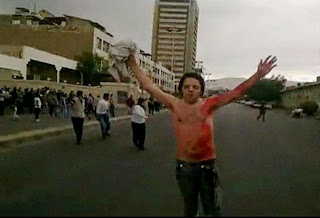
Also, official news sources help readers learn more about an issue, whereas most amateur writing (see: commentary) is simply a way to ignite a discussion (at least in my experience). For example, when the Neda Agha Soltan video was going viral, I (and countless others, I'm sure) took that as the spark and began to look up articles published by traditional sources for more information. We need citizen journalism so nothing goes unreported or suppressed regardless of location, regime or access, and we need established and trusted journalism to put those things in context for us.
An example of mass amateurization gone off track that demonstrates the need for traditional media (as a regulator of some sort) was Amina Arraf – better known by her blog title “A Gay Girl in Damascus” (which used to be here but has been removed). Earlier this year, as people in Syria were revolting and protesting, word about Arraf’s blog began to spread thanks to the Web and soon, she had countless readers praising her courage in being an openly lesbian woman in a Syria caught in turmoil. And not just that – Arraf’s poetic writing also spoke out against the regime. Arraf’s writing represented the voice for Syrians in general, but also the voice of marginalized gay Syrians, living in a dangerously rigid society.
On June 6th, a post on the blog made by Arraf’s cousin stated that Arraf had been kidnapped (presumably by order of the government). The news erupted around the world, especially in the U.S., with LGBT rights organizations speaking out for Arraf and demanding her release. Stories like this were top hits for a quite a few days….until everything fell apart.
After thorough investigations, it was found that the blog was actually written by an American named Tom MacMaster – there was no one named Amina Arraf, and there had been no kidnapping. While the details of this specific story alone are very interesting (along with MacMaster’s explanation for why and when he created the character), the story is illustrative of how the idea of anyone being able to publish and the speed at which this published work goes viral can both be good and bad. The truth is that most people do not take the time to verify information on the Web – “if it looks like it’s in article-format, it’s probably legitimate.”
“Arraf’s” story was propelled into the traditional media realm by bloggers on the Internet and finally the truth was discovered. The point is that, like anything else, mass amateurization has its fallbacks. Traditional reporting and journalism can adapt a new, and just as essential, role of filling in these loopholes.

Will the real Slim Shady Amina Arraf please stand up? Tom MacMaster (above), who created the character of Arraf.

Source:

Shirky, Clay "Everyone is a Media Outlet." Here Comes Everybody: the Power of Organizing without Organizations. New York, 2008.

Photo: Courtesy of Washington Post Here


Post 3


In "Everyone is a Media Outlet" Clay Shirky reveals that in the present time everyone can be publishers and photographers. This is due to the technological tools we have. Nowadays almost everyone has a digital camera or a camera in their phones and they can share the images through the internet. This is Shirky's idea of "mass amateurization." He says, “…anyone in the developed world can publish anything anytime, and the instant it is published, it is globally available and readily findable” (71). In other words, anyone can publish whatever they want and it can be seen within seconds, thanks to social networks such as Twitter, Facebook, or Blogger. Shirky gives an example of how this “mass amateurization” affects media. His example on Trent Lott’s comment on the fact that his state, Missouri voted for Strom Thurmond in the 1948 presidential campaign and that the country would be better off if Thurmond had won, showed that the media is changing. The professional reporters disregarded Lott’s statement, while, bloggers were writing about it and making comments on Lott’s statement. This brought people’s attention thus, causing Lott to speak out about his comment. After that the newspaper, T.V, and radio reporters started to consider this situation as “breaking news.” This example showed that the world was changing in that it was once a time where the professionals decide what is important and what is not important. Now people can have a say in what news is important, because they are now publishers.

A personal experience I have with “mass amateurization” is that every day I find news through YouTube, Facebook, and Twitter. For example I did not know about the earthquake in Haiti until I saw a tweet on Twitter that said, “My prayers go out to the people in Haiti.” After seeing that, I “googled” news on Haiti, and found out about the earthquake. It’s amazing how people can just get news through an average citizen, instead of a news anchor. Another example on “mass amateurization” is that my cousin from Hong Kong posted a video of a flood that was going on there, and she showed that the water was up to her ankle, and people had to walk around with that. I would not have had a clue that there was a flood in Hong Kong if I had not seen the video. There are many examples of “mass amateurization” and it will increase as time goes by.

Clay Shirky also mentions that there is no longer scarcity in professionals such as journalists and publishers. Since, anyone can be their own publisher. In this he questions whether the professionals are going to be needed in the future. He questions whether the journalists and publishers would end up like the scribes. Shirky even poked fun at the fact that De Laude Scriptorum was contradicting its own purpose. For the book explains why scribes were needed and why they cannot be eliminated, yet, the book itself was not copied by scribes. Instead it was copied through movable print. The fact that De Laude Scriptorum used the very medium that it is protesting against, puts the scribes out even more. Shirky says, “The content of the Abbot’s book praised the scribes, while its printed form damned them, the medium undermined the message” (68). In others words the contradiction cancelled the message of the book out.

In using the scribes as an example, Clay Shirky is trying to say that with technology and social networks increasing, professions are dying out and professionals are no longer needed.
He stresses that soon journalists will be gone just like the scribes. Shirky shows that history is repeating itself when he says, “Faced with radical new efficiencies, those very firms are working to make moving movies and music harder, in order to stay in business—precisely the outcome that the bus company (and the Abbott) was arguing for” (79). The professionals are trying their best to stay in the game but sooner or later they will be like the scribes and die out. However, the movie industry and the music industry are trying to make production harder, so the amateurs cannot compete with them. Shirky believes they will soon catch up, but the movie industry is doing just what the scribes wanted to do. They are challenging the amateurs.

Although it seems as if the future for media professionals are doomed. I feel that professionals will always be needed. Professionals compete with the amateurs. If the amateurs blog they will blog as well. I see this in the CW News at Ten crew. When I go to the CW website I see that the news anchors are trying to get their viewers’ attention by blogging on their CW profile. This is why I feel like the media professionals will not die out. Whatever new medium comes their way they will use it too, just like the amateurs. Another thing is that although we have all these new tools, people are still needed. For example, the supermarkets are trying to add more self checkouts. However, these self checkout machines still need a person to guard them and make sure the costumer does not steal or does not make a mistake. Machines cannot be left alone, there are always technical difficulties. Another reason why professionals will continue to have a profession is because sometimes people just prefer to have work done by a professional. For example, although people can take pictures of themselves, some people still go to photographers to get their picture taken, because they have a psychological feeling that professional is better. Just like how most people would go out of their way to buy brand name electronics, clothing, food and other stuff, rather than something with no brand. They just feel better, psychologically, to use money and have a professional get the job done.


References:


Shirky, Clay. "Everyone Is a Media Outlet." Here Comes Everybody: the Power of Organizing without Organizations


Mass Amateurization - Edina Kacic


Clay Shirky, author of Here Comes Everybody opens his chapter, “Everyone Is A Media Outlet” with a short paragraph about social tools we use today. “Our social tools remove older obstacles to public expression, and thus remove the bottlenecks that characterized mass media. The result is the mass amateurization of efforts previously reserved for media professionals” (55). A lot of people complain about the Internet and social media especially as ruining society in many different ways but as Shirky explains, social media is in fact empowering young people in ways that many believed to be unimaginable.


Shirky discusses the idea of the “professional” in this chapter, quoting UCLA sociologist, James Q. Wilson. “A professional is someone who receives important occupational rewards from a reference group whose membership is limited to people who have undergone specialized formal education and have accepted a group-defined code of proper conduct” (58). Basically, a professional is one who has gone to an institute of higher education and knows how to behave in certain situations.


The discussion of amateurism is first mentioned as copyability as described by Shirky. “As new capabilities go, unlimited perfect copyability is a lulu, and that capability now exists in the hands of everyone who owns a computer. Digital means of distributing words and images have robbed newspapers of the coherence they formerly had” (59). What can be considered the “problem” with amateurism is what makes it such an amazing thing that people can take part in. The “problem” is that with social media tools, news can be shared and posted faster than ever, much faster than a newspaper can print the same story. Why should people have to wait until the morning newspaper to be printed in order to receive news that might have happened in the middle of the day. And sure, television news outlets might be able to call “breaking news” and interrupt whatever programming might be on the television at the time but how fast can reporters and their cameramen arrive on the scene of whatever news? The reason why amateurism is so successful is because with the use of a camera phone which everyone has today, an event can be captured and posted onto Facebook and Twitter with the click of a button. Today, people should be worried that a news source - online, printed or otherwise - is engaging in copyability of amateur reporters. Why can CNN take a video of something a citizen at the scene taped via their cell phone and then post in on their website as breaking news? Because of the whole idea of “professionalism”. CNN reporters are “specially trained” to report on the news and events of the world because they have graduated from a university and have all the world’s experience and other things that make me say blah blah blah.


An interesting point that Shirky brings up is Martin Luther’s 95 Theses during the Protestant Reformation. He writes, “Two things are true about the remaking of the European intellectual landscape during the Protestant Reformation: first, it was not caused by the invention of movable type, and second, it was possible only after the invention of movable type, which aided the rapid dissemination of Martin Luther’s complaints about the Catholic Church (the 95 Theses) and the spread of Bibles printed in local languages, among its other effects” (67). The interesting point about the 95 Theses is that even before social media, the 95 Theses were “passed” around widely due to people posting them all over in different places kind of acting as amateurism in itself.


The media professional will always be largely based on social media tools. As long as people are becoming more empowered by citizen journalism as discussed by Ralph E. Hanson in Chapter 10 of his book, Mass Communication: Living in a Media World, amateurism will be long lasting. The reason why citizen journalism is becoming such a powerful thing is because it is allowing people who are denied a voice to express themselves via another medium. The best example of this is discussed in Hanson’s chapter with the story of Neda Agha-Soltan whose death became known as “probably the most widely witnessed death in human history” (The Top 10 of Everything 2009, Time). Had the story not been filmed on the spot by people with camera phones, the world may never have known about the “unintentional hero” who was shot in the heart.


I end my post as what I think to be unfinished. As I learn more about amateurism and citizen journalism, I hope to become better at understanding what this could possibly mean for myself and my future. As of right now, LONG LIVE AMATEURISM and CITIZEN JOURNALISM!


References:


Shirky, Clay. "Everyone Is a Media Outlet." Here Comes Everybody: the Power of Organizing without Organizations. New York: Penguin, 2008. 55-80. Print.


Hanson, Ralph E. "Chapter 10." Mass Communication: Living in a Media World. Washington, D.C.: CQ, 2008. Print.


Time Magazine http://www.time.com/time/specials/packages/article/0,28804,1945379_1944701_1944705,00.html

Wednesday, August 3, 2011

Everyone is a Media Outlet (Michael)


When asked to talk about mass amateurization one must first explain what the phenomenon is. For hundreds of years professionals were the ones always leading the charge in various fields of trade. While some people would follow suit in a casual fashion the ones at the helm where always the professionals. Today though the world is a much different place, where the amateur is slowly gaining more and more power to the point that more and more information is coming from them. This change being brought about thanks to the ever growing internet.

Mass amateurization is happening in several places in the professional world, but no where is it's influence more strongly felt then in the media, particularly the news industry. Here according to Shirky sites like eBay and Craigslist, where anyone can request a good or service , have been moving into the territory of classifieds and is cutting off that form of advertisement from the tradition print media (56). Journalists are also facing harsher competition from the rest of the world. As Shirky says "anyone can be a publisher" and this is the founding principle of the mass amateurization (77). When anyone can post a video of events uprising in the Middle East or update their Facebook about the events of an earthquake they are now the journalists breaking news as it happens even though they probably don't see themselves as such. This change is caused by simple odds. When any given event happens the odds of a professional journalist being there are slim, but odds of a passerby walking by and being able to take pictures of even film the event or almost to the point of being guarantied.

There are many ways these effects can be seen such as the ever increasing popularity of blogs or video sharing sites like youtube. However the example the I feel most resinates with the issue of mass amateurization is the site that guy with the glasses and its leading man Doug Walker. A person who started out like many others as a simple youtube user has found such success with his videos that he and some of his close friends have started up a company for the site. It has since grown to host videos from many different people covering many different topics of interests. Not only is he living many internet users dreams, but being able to go from making amateur videos into having that be his profession blurs the line between the two.

One of the big things the Stirky talks about when future of this increasing control of news to those that normal are the consumer (62) and the blurring of the line between professional and amateur (72). When the Senator Lott made a pro racist comment at a dinner one night the professional media hardly blinked since they didn't think to think of it as being news. However millions of bloggers took up arms at the remarks and eventually the "mass media" was covering the story as well. Continuing the blogger trend Stirky also brings up the issue of what happens to the people that live on the line of amateur and professional. Bloggers aren't professionals, but what about the professionals that use blogs? What of bloggers that end up crossing the line and end up as professionals, was what they posted when they were "just bloggers" professional news? Clearly the line between the two is becoming more and more blurred and will only get worse over time.

This now begs the question, what does the future hold for the media professional? Personally, I think they will continue to go strong. While amateurs will increasing be the ones able to break the news on a story they will never be able to cover it the way professionals do. This is obviously due to the funding available to the professionals and as such they will be able to investigate things more fully and odds are write more eloquently then we can as the common folk. The other major issue facing the internet is the issue of trust. When anyone can post anything online it can be hard to tell if the crossed their "t''s and doted their "i"s when getting the information they are reporting on and so the chance of them being misinformed or them misinterpreting things is much higher. As such journalists should be able to sleep soundly knowing they will have a job when the wake up in the morning.

Shirky, Clay. "Everyone Is a Media Outlet." Here Comes Everybody: the Power of Organizing without Organizations. New York: Penguin, 2008. 55-80. Print

Mass Amateurization


By mentioning mass Amateurization in the ''Everyone is a media outlet reading'' Clay refer to the fact that nowadays at the point where we are in the advancement of the world , everybody who have access to internet can be a media giver it doesnt mean that media professional do not exist , they still are a round but since more and more people because of the internet, are doing similar job about media that a professional used to do, the impact those profesional used to have in the media business they used will no longer be a huge one . Now people dont have to rely just on the professional work to know what is going on around the world but they are in a way or another being media maker.The media that used to be handle by a very selective group of people is non longer the case. citizen journalism which is a big part of the media world is allowing people i mean ordinary one in around the world to have the possibility to record or write stories , news, events that they witness and publish through internet so that people can see them and be aware of them.

The example I will give related to that particular case is the Syria protest again the regime of the president Bashar Assad. the regime did not want the events that stated the Syria revolution to be seen in all around the world because of the bad side it had in it but also they did not want the world to know that Syria have problem in the first place . Many Syrians were killed during those early protestation and the only way people knew about it since the regime did not want any journalist to enter to Syria and report on it , was the effect of the citizen journalism. Syrians protestant were able with their phones or their camera to send pictures or information about what was going on and the regime was unable to control that . Its true that the pictures were not professional pictures but it brought awareness around the world concerning the syria issue. Citizen journalism had play a huge deal about the Syria problem and still now its had for reporter to enter to Syria and report about what is going on in a very specific and with a lot of detail. The Good thing about the isse is that now beside all the governement effort to hide the problem and banalise the killing of innocent civilian, the world is aware of it.Actions are being taken by the UN in oder to solve the problem.

According to Clay Shirky, media professional will no longer be the big thing it was years ago but a thing that will be share by everyone. People will be media literate and any one who can have access to the internet will be able to write, and publish things that can be view by people any time and any where.We living in a world were information is no longer secret, where people can communicate to each other very efficiently. Media professional may still exist but it will no longer be a myth and everyone in somehow will be able to rely on people not only professional media like it used to be to get news and know what is gong on .


Generally most big events that are happening now are being recorded by people and published even before the professional put their hand on it and many example can illustrate that argument . for example the earthquake in Japan, many people who had relatives in Japon knew what was going on long before they started seeing it in the TV because Japones people were texting or sending messages about the event to friends and relatives one around the world.the statut of a professioonalim in the media worl now is just a title .Things have gotten so better ,that there is no need to wait for profesional journalist to cover an event for people to know what is going on.

http://cryptome.org/info/syria-protest/syria-protest.htm


"Here comes everybody"chapter3 by Clay Shirky

Mass amateurization

Credit: Mediabistro


Mass amateurization, according to Clay Shirky, is "a result of the radical spread of expressive capabilities" (p. 66). In other words, mass amateurization happens after a means of communication rises. For example, shortly after the printing press was invented, literacy spread as a result. Reading and writing were once skills limited to scribes; now these skills have spread amongst the general public. 


Mass amateurization, essentially, takes the skills that were once only entitled to professionals and gives the general public access to those skills. It's like the decentralization of the feudal system. Of course, this does not mean that the general public becomes professionals. It's just that the skills that were once limited to professionals are no longer limited to professionals. 

With the creation of the Internet, a lot of professions have been mass amateurized. For example, YouTube gave amateur video makers a platform to show off their videos, whether they were professionally done or not. Another example are computer programs that gives users the tools that professionals use to do their work. I made a picture slideshow with Windows Movie Maker. That was very easy, I didn't need to go to Rite Aid or Walgreen to have a professional do that for me. Last year, I had to renew my passport so I went to professionals at CVS to get my passport picture taken. They wanted to charge me $10 for 2 small passport pictures while they charged 20 cents for a one 4X6 photo. I decided to take my own passport photo with my digital camera. I printed it at Target for only 25 cents for 6 copies. I wasn't a professional photographer but I was still able to take my own passport picture. 

The outcome of mass amateurization, according to Shirky, is "the loss of professional control [which can be] bad for many of society's core institutions" (p73). Because of mass amateurization, there is less demand for the professionals. Because there's less demand, the profession will start to fade out. The professions, however, won't necessarily fade away completely. It will depend on if that profession is still valuable. For example, in the case of the scribes, scribes are no longer a profession, instead they sort of morphed into calligraphers. Professions that get ousted by mass amateurization often become valuable hobbies like telegraph operators. Although they are no longer a profession, Morse code reading skills are still valued hobbies. 

I don't think mass amateurization will kill the media professions. Even though, the average Joe or Sally today, can be a journalist, photographer, or video maker, they are not professionals. They are amateurs. Well, most of them are amateurs. Some may be talented enough to become professionals. The difference between professionals and amateurs in in quality and credibility. Professionals tend to produce high quality material while amateurs may not necessary have the professional equipments to do so but that is changing quickly. The one place where amateurs might win over professionals is in creativity. Professionals also tend to be more credible than amateurs because professionals are seen as experts in their fields. 

Source: 
Shirky, Clay. "Everyone Is a Media Outlet." Here Comes Everybody: the Power of Organizing without Organizations. New York: Penguin, 2008. 55-80. Print.

Mass Amateurization Post (Kunal)


(Image Source)


The “mass amateurization” described by Clay Shirky in “Everyone is a Media Outlet” describes how methods of communication which were once scarce and required the knowledge and experience of a professional became available to the masses because of a combination of several factors like cost, availability, and ease. He argues these shifts have allowed anyone to engage in transmission of messages and have displaced a considerable amount of need for the knowledge and access in the domain of the professionals like those in major media companies.

His argument could not possibly be truer given how as Shirky puts it, “anyone can be a publisher” (71). With the rise of the internet, people can publish any message they please online for the world to see and interact with. It’s been made possible by practically non-existent costs and the great availability and ease of use of many tools that allow such “self-publishing” to be possible. The smart device assumption (77) Shirky mentions is a large part of this because free or inexpensive web tools and computers are capable of doing just as much as the expensive tools other media forms like television use with greater flexibility and control for their users. Subsequently, it’s natural that media professionals would no longer be as necessary if it’s now so easy for any “amateur” to post their thoughts. Shirky says that the outcome is that the control professionals have over the media has loosened and the ways to find and interpret information has multiplied. He exemplifies this with the Trent Lott story gaining traction thanks to the writings to web blogs and with the volume of photos shared on iStockphoto.

I can personally vouch for his argument because I’ve followed and can find plenty of these “amateurs” who can often give me what professionals cannot give as well, if at all. Since I’m a gamer, I frequently search around the internet for the latest videogame and technology news. While there exist many large websites for these news like IGN, 1UP, CNN Tech, and Gamespot, I often find some more in-depth news first, if not only from the smaller or unlikely sources. For example, I can often find some information about a specific game in forums like GameFAQs and see it nowhere else or many days later on another larger site. A friend of mine managed to dig up considerably more information on Marvel vs. Capcom 3 from there forums. Without this “mass amateurization” I would never be able to find much of this game information because the big media has not and cannot cover it, you could only test a game by borrowing it from someone else before the internet, and the publisher will only reveal so much about a game before you actually buy and play it. But now that anyone can post this information, I can often find out everything I need to know about a game before I even consider a purchase and even see complete footage from a videogame Let’s Player. These “amateur” sources of information are often better than the big gaming sites as the pressure for skewed reviews to get advertising is completely absent.

I definitely think that the media professional will still have a prominent role in the future and will co-exist with the amateurs. Although Shirky says the distinction between professional and amateur is becoming more difficult, the two can still co-exist because their vastly different resources mean they can target different audiences. If the media professional truly had no future, we wouldn’t have so many recognizable and respected journalists or photographers like Annie Leibowitz. The professional’s primary advantage is that their greater number of resources allows them to channel their messages to a considerably larger audience, something that amateurs generally can’t boast. The Trent Lott story Shirky mentions got a largely increased amount of attention because the press’s decision to pick up the story from the web blogs greatly increased who was exposed to it. Nonetheless, the professionals will definitely forfeit some leverage they previously had because anyone can publish anything they choose without worrying about the cost or permission to publish. Ultimately, I expect something big like a large group of professional pictures or a big, high-interest story to be covered by professionals because they can reach a larger audience while more specialized news or specific coverage professionals can’t touch such as the gory murder of Neda in the Iranian election protests we talked about. I see a resemblance to a short head and long tail model with this “mass amateurization.” The big media companies will deliver smaller amounts of information that many are interested in as they can reach a larger audience and need to recoup large costs. Amateurs on the other hand, can easily deliver considerably more information that mores specialized or can’t be touched by the professionals at little to no costs for the long tail end of this model.

Ultimately, I see a future where “mass amatuerization” tools will be used to bring about information not normally covered by the professionals. The professionals will not become obsolete because their services will still be necessary to reach a larger audience they have already established. They will still be distinguishable from the amateurs because there is still value in their resources to reach bigger audiences and if there wasn’t, famous journalists or photographers wouldn’t still exist.

Works Cited
Shirky, Clay. "Everyone Is a Media Outlet." Here Comes Everybody: the Power of Organizing without Organizations. New York: Penguin, 2008. 55-80. Print.